Compost Turner: This Tool Works for Home Bins

Compost turners are great for homemade bins! Typically, when you make a homemade bin, the opening will be large and there will be a lot of room for excess compost and organic material. This means the compost has to be turned with a certain frequency – as there is no tumbling motion such as seen in rotating or tumbling composters.

So, when you purchase a compost turner, you are able to properly aerate and mix your compost in a matter of minutes. Using a tool is simple – just plunge it into the compost and then move it and mix the compost around. It’s that simple. You are then able to blend the different elements in your compost bin together, make sure they get the proper amount of exposure and aeration, and then let nature do the rest of the work. A compost turning tool works twice as well as a shovel or pitchfork, and really lets you get down deep into the soil.

Compost Containers for the back yard

So you desire a compost container for your backyard. No problem. It’s important to determine what sort of compost container you are looking for. Do you want a spinning or rotating bin, an open bin in the backyard that you just throw stuff in, or do you even want to venture down the homemade route? Well, let’s take a look at the different styles of bins/compost containers to help you come to a decision you are happy with, shall we?

Tumbling/Spinning/Rotating Composters

Photo found on Flickr.com courtesy of Clean Air Gardening.

These composters are nice because they make compost in little to no time, by comparison. They are typically above ground, and you place the compost in, spin it, and in anywhere from 3-8 weeks (depending on the composter), you have some rich, luscious, black gold for all of your gardening aspirations. That’s nice. These bins work in such a fashion that it’s easy to load compost in, keep it covered (so you don’t have to work extra hard to keep pests, animals, and rodents out), and you can reap the benefits of great compost in the end.

Multi-Bin Compost Systems

These compost bin systems are really nice, especially if you are looking to producing large amounts of compost. The basic concept is to have a few different compost bins that can be representative of the different stages of compost. Because of this, you can have multiple compost piles going at once. If you so desire (and have a lot of waste – and we mean a lot) then you could essentially have a few compost piles going at the same rate. In any case, a multi-bin system is perfect if you have a lot of work to do, and know for a fact you will need large amounts of compost.

Wire Compost Bins

Photo found on Flickr.com courtesy of LAJ2006.

The wire compost bin can be easy to make – all you need is wire, wire mesh, and some stakes. The bin is just what it sounds like – a wire mesh area that sits in the lawn and you make compost with it. Since it is wire mesh, it keeps the compost aerated. It is easy to construct, and simple to maintain. If you are worried about animals, however, there is a greater chance that they may be able to get into the bin and mess with any of the compost. If that is a risk you are willing to take – these bins can be quick and easy to getting you on the way to making some compost. There is a great book, titled Basic Composting: All the Skills and Tools You Need to Get StartedA that shows you how to construct this style of bin with ease.

Home-made Composters
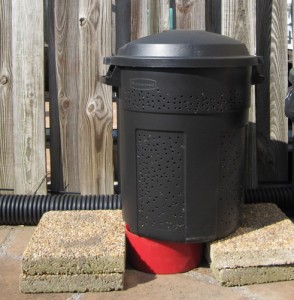
Photo found on Flickr.com courtesy of Katxn.

These can be fun, and you can use your imagination – you can make a compost bin out of anything – from wood, to a trash can, wire mesh (as mentioned above)…the possibilities are endless. Just remember this – you need to make sure your bin is properly aerated, and when placing stuff in the composter, just make sure there is an ideal Carbon-Nitrogen ratio. Basic Composting also has some good insight to other styles of bins, so do websites mentioned in an earlier blog post, titled “Make a Compost Bin.”

Garden Compost Tumbler: a roundup of models

Tumbling compost bins allow you to mix the material by “tumbling” or rotating everything in a large bin. This is nice, because it eliminates the need for a compost fork or a compost aerator, and really just makes mixing up your compost a quick and painless ordeal. Here is an overview of some different tumbling compost bins/styles:

The Traditional Compost Tumbler:

Tumbling compost bins such as the Tumbleweed are your traditional compost tumblers. Some these composters only have space at the top, while others (such as the tumbleweed) have spaces at the top and bottom to load in your material – leaves, grass, banana peels, apples, carrots – you get the picture. The nice thing about a bin like this is that all you have to do is just load the material in, seal the lid, and give it a few spins. That’s it. The overall compost time will be sped up and you will be on the path to righteous compost quicker than you can imagine. These bins are usually elevated off the ground as well, which is a totally nice feature. By resting off the ground, you don’t have to worry about animals getting into your compost and bringing havoc upon your life and lawn.

Spinning Composter

Photo found on Flickr.com courtesy of Estacey.

A spinning composter, such as the Envirocycle is another excellent way to get your compost on. This style composter is circular and spins on metal rods, so there’s an air of fun to it, and it’s not that bulky. As mentioned in the product review, the Envirocycle in particular is nice because you can just roll it to other areas of the lawn, and it produces up to 5 gallons of compost tea. Quite the nutritious, tasty treat for your plants, vegetables, fruits, and lawn. Because of the spinning nature of this style of composters, compost is also produced quickly – typically in a range of 3-6 weeks. In just a short time, you will be ready for some finely composted material for your gardening needs.

Dual Chamber Compost Tumblers

These bins come in handy because they have two chambers. While one of the chambers is being filled with organic material, the other chamber can be used to mature the material into rich compost. When your material is ready to compost, you can empty out one cycle of the bin and then begin anew. This is perfect, because essentially there is a continual cycle of compost. In addition, these bins often sit off the ground, and are good if you are looking to resist attack from rodents, animals, or various other pests.